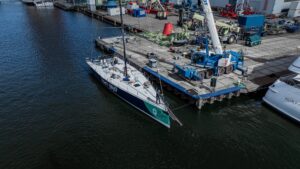
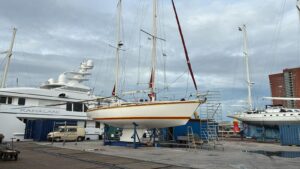
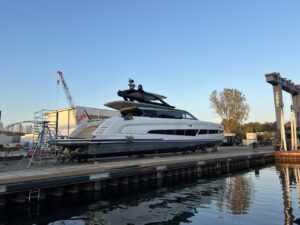
When a shipyard’s refit project needed to be lifted out to undertake remedial works ashore, Amsterdam Yacht Service proved to be the ideal choice – and as it turned out, not just for its yard facilities and location. The project in question involved a vessel originally constructed in the middle of the last century, but as the refit team peeled away the layers to address corrosion around the vessel’s steel rubbing strake, they uncovered a very specific, and very hazardous, problem – the presence of chromium-6 paint.
Chromium-6 – also known as chromium (VI) and chromium hexavalent – was often used as an additive in rust inhibiting paint on vessels, and particularly on hulls, but as a heavy metal it carries with it significant health risks particularly as a carcinogen. While its use has now been banned in the EU, it can still be found on older vessels. Like with asbestos, chromium-6 removal or remediation requires a strict procedure based on exhaustive safety protocols due to its toxicity. It is here that Amsterdam Yacht Service was able to step in and move from merely providing hardstanding and support facilities to active involvement in the refit ensuring the safe handling and removal of the chromium-6 paint.
“When the refit team removed the stainless steel rubbing strake due to corrosion issues, their due diligence uncovered chromium-6 paint, although it wasn’t applied when the vessel was originally built and it wasn’t found everywhere,” begins Robert Binnekade, managing director of Amsterdam Yacht Service. “So basically they asked us for help and we designed a working method and procedure to remove the paint based both on recommendations from the government and also from our own past experience.” Drawing on established procedures for the removal of asbestos, the AYS team devised a working procedure that they then shared with the local municipality for approval. Their solution covered two different methods, the first being removal using a hydro-jet, and the second through a grinding process. In each case, the team developed working procedures to ensure the chromium-6 residues were safely encapsulated, through vacuum extraction and storage by turns of the waste jet water and any airborne particulates. Further, the protocol included strict post-work procedures for both the workers and the equipment to ensure absolute safety and zero contamination.
“The hydro-jet method minimised the amount of chromium-6 paint or particulate matter created as it was held in the run-off water that we could easily extract,” says Binnekade. “Then when we switched to the grinding method – because the underlying metal wasn’t in a suitable condition to act as a substrate for the new paint system – we switched to a vacuum extraction system to mitigate and contain any airborne contaminants. Both methods include environmental isolation, a fully covered scissor lift that gets washed down every day, and a remote shower unit where all workers on the project can dispose of their coveralls, shower and essentially decontaminate,” he continues, “just as they would if working on asbestos removal or remediation.”
The project reinforces the diligence required when working on older vessels, as well as highlighting the skills and knowledge contained within the AYS team, which also has field test tools that can give an indication of whether chromium-6 paint is present. If it is, AYS clients can rest assured that the shipyard has the approved methods to deal with it safely and effectively – and those same methods can also be applied to any other untoward materials or coatings.
“This will not be the only vessel out there with chromium-6 or other problematic substances,” Binnekade concludes, “but rest assured the potential issues can be mitigated through experience and good working practice in removal or remediation – that’s where we can really help, and that’s another reason we draw clients from across the leisure, tourism, superyacht and commercial maritime sectors to our AYS shipyard.”
If you have a project where you suspect the presence of chromium-6 or other hazardous materials, reach out to the Amsterdam Yacht Service team at info@amsterdamyachtservice.com to find out how they can help.
VIDEO: Classic Yacht Renovation – Preserving a way of life
A classic yacht is a legacy, and we treat it that way. We restore your yacht to its original glory, without losing its soul. We blend old craftsmanship with modern technology. Amsterdam Yacht Builders brings your classic back to life. Read more about our Classic Yacht Renovation services here.
Race relations
Amsterdam Yacht Service sees all sorts of projects arrive for all sorts of works, but sometimes there can be a bit of a change of pace. Enterthe VO65 Team JAJO, a true round-the-world racer with the credentials to back her up. First launched for the 2014-2015 edition of The Ocean Race, where she placed second […]
Monaco Yacht Show & METS Amsterdam
Amsterdam Yacht Service is pleased to share its upcoming show calendar for this season. Robert Binnekade will be attending the Monaco Yacht Show, and would be delighted to meet with clients to discuss all their service, maintenance and repair requirements. Whether you have a specific project in mind or simply wish to explore how our […]
Atlantic returns
Getting repeat clients is always a thrill, not just because it’s testament to the capabilities Amsterdam Yacht Service offers, but also because it’s like greeting old friends. We were especially thrilled in late Spring this year to welcome back the mighty 64.5-metre schooner Atlantic, who trusted the AYS team to help with some involved work […]
BLOG 6. “Hull 405: Classic Lines, Modern Heart”
It’s been a while since we’ve blogged about our 17-metre Pieter Beeldsnijder-designed motor yacht that we acquired part-complete in 2023. That’s partly because we’ve been so busy with a vast array of other projects that have been coming through the yard – from stunning sailing schooners like the 64.5-metre Atlantic to sections of a bridge […]
From Mandarine to Melody
It’s no secret that Amsterdam Yacht Service caters to an incredibly diverse range of clients, from motor yachts to commercial vessels, tourist boats, and even – on occasion – civil engineering companies floating sections of bridges into place. Few could argue, however, that the stars of the yard are the stunning sailing yachts that make […]
VIP treatment
It’s not only yachts, tourist boats and commercial vessels that get a revamp at Amsterdam Yacht Services – the shipyard itself is constantly upgrading its facilities. Most recently, AYS has taken a proactive approach to expand the drainage and water treatment system that serves the one and a half hectares of hardstanding, where vessels will frequently undertake out of water repairs and maintenance.
Five stars for Three Point 4
While a lot of the more intensive work we undertake at Amsterdam Yacht Service revolves around refit, repair and maintenance of steel and aluminium vessels and their systems, our team has the flexibility to tackle pretty much any material. That was ably demonstrated this winter when we took in a 29-metre Maiora called Three Point 4 for various works.
Holy Trinity
While the Amsterdam Yacht Service team brings a wealth of experience and expertise across a broad range of disciplines, they will still freely admit that every day is a learning day. In the case of the 16m Amel Super Maramu sailing yacht Trinity, the learning came from the yacht’s owner who, in the course of outlining how she wanted the yacht’s interior refreshed, showed the potential of AI as a quick visualisation tool.
Home away from home
One of the things that always strikes us is the vast array of projects that float through the Amsterdam Yacht Service facilities, from classic sailing superyachts to commercial vessels, tourist boats, and even bridge components.
Merry Christmas and a Happy 2026
2025 has been a dynamic and rewarding year for Amsterdam Yacht Service. Our team has continued to expand and refine its expertise, successfully delivering a diverse range of maintenance, refit, and custom projects for clients across the globe.
Multiplying returns
It’s perhaps the greatest compliment we can receive when customers come back for a return visit to our state-of-the-art facilities in Amsterdam. Sometimes it’s for larger works that make use not just of our hardstanding areas or large sheds but also our expert inhouse team of engineers, carpenters and fitters – and sometimes it’s for general maintenance jobs.
Join AYS at Metstrade 2025!
The Amsterdam Yacht Service team will be present at the Amsterdam RAI exhibition centre for all three days of Metstrade, 18–20 November 2025. It’s the ideal moment to meet us in person and discover more about our state-of-the-art facilities and onsite expertise: everything you need to ensure your next build, maintenance, or refit projectruns seamlessly from start to finish.
Meet us at the MYS
Members of the Amsterdam Yacht Builders team will spend two days in and around Port Hercules this week as they visit the Monaco Yacht Show. If you would like to meet up and discuss any potential project we would be delighted to do so on Thursday 25 and Friday 26 of September. It’s sure to […]
Happy days
The long summer days are finally here, and it’s time for most yachts to switch from maintenance mode to magical-days-on-the-water mode. For the team at Amsterdam Yacht Service, of course, the work never stops – even during summer, we have vessels coming through for haul-outs, services and all manner of works.
Atlantic crossing
Few things can match the glamour, beauty and sheer elegance of the 64.5-metre sailing yacht Atlantic – a 2010-launched recreation of the original schooner Atlantic which first touched the water in 1903.
Simplifying survey
While the Amsterdam Yacht Service team can turn its hand to pretty much anything, and while the shipyard itself can handle pretty much any type of vessel, not every project involves complex hull repairs or hotwork.
A bridge too far?
We pride ourselves on the variety of vessels and projects we work on here at Amsterdam Yacht Service – from yachts to tourist boats to commercial vessels and workboats, they all come to take advantage of our in-water berthing, haul-out and hardstanding, refit sheds and inhouse expertise.
Near and Far Niente
It’s perhaps fitting that a 32.7-metre modern classic motor yacht styled after the Dutch herring luggers of the early 1900s should land in a Dutch refit and maintenance specialist shipyard, and that’s exactly what happened in the Autumn of 2024.
The gold standard
It’s one thing finishing a summer season then heading to a shipyard with a list of works to do over the winter and plenty of time to complete that list – but quite another when you arrive in the Spring and need to get those works completed in time for the summer charter season.
BLOG 5. ‘The making of a modern classic’ – An inside job
As we make steady progress with the construction of Hull 405 – the Pieter Beeldsnijder-designed 17-metre steel yacht that had laid part complete for two decades, before we acquired her in 2023 in order to finish her build – we are starting to think about some of the fun stuff.
A true Grand Dame: AYS-refitted superyacht wins major St Barths Bucket prize
Excellent news reaches us from the Caribbean of a stunning performance by one of our recent projects. A key remit from the vessel’s highly experienced owner for the refit of his 56-metre Perini Navi Panthalassa was to bring her technically up to speed and highly competitive in sailing races.
BLOG 4. ‘The making of a modern classic’ – Redesigning the aft end
If there’s one thing we’ve learnt here at Amsterdam Yacht Service after decades of experience working on commercial and, in recent years, yacht and superyacht refit and rebuild projects, it’s that you don’t always need to go for the most high-tech solution in every aspect of the vessel.
BLOG 3. ‘The making of a modern classic’ – Creating a 3D hull scan
With the classic Pieter Beeldsnijder 17-metre steel yacht hull – known as Hull 405 – safely ensconced in our advanced facilities, the team has been able to begin the detailed engineering work needed to bring the hull to completion.
Base jumping
While the Amsterdam Yacht Service teams are always on hand to assist with serious project work – from hull replating and finding solutions to other engineering challenges to the capabilities of the new woodworking department – the extensive AYS facilities are also highly prized by other shipyards and superyacht builders who need a base for […]